

Opportunity Area
94% of Americans fall short on Vitamin D, 48% miss their Magnesium target, and getting answers can take over 35 days. Apple Health tracks movement, and Cronometer tracks food, but neither connects body signals to a clear next step.
InTrack is a speculative health product and working software prototype. It explores how a clip-on wearable, optional blood-test calibration, and personalized guidance could help people understand nutrient trends and act sooner.
My Role

I led the product design and built the full React prototype with Claude Code, translating the strategy, hardware concept, Figma system, user journeys, shared state, and AI flows into a working product. I defined its behavior, broke it into buildable systems, reviewed outputs, fixed failures, and shipped the final experience.
Highlights

Highlights
Metrics & Values

Metrics & Values

Final Product
InTrack is a wearable health concept that combines estimated nutrient trends with personalized actions. It is designed as a small sensor module that clips onto a band users already own, rather than asking them to replace their current wearable.
Users can upload a recent blood test to calibrate their baseline or skip it and continue with clearly labeled **Estimated** insights. Based on their goals, they can choose a Supplement, Diet or Hybrid journey.
The app then connects insights to actions through meal guidance, supplement tracking, teleconsultation, and an AI-assisted food-ordering flow.

Final Product
InTrack is a wearable health concept that combines estimated nutrient trends with personalized actions. It is designed as a small sensor module that clips onto a band users already own, rather than asking them to replace their current wearable.
Users can upload a recent blood test to calibrate their baseline or skip it and continue with clearly labeled **Estimated** insights. Based on their goals, they can choose a Supplement, Diet or Hybrid journey.
The app then connects insights to actions through meal guidance, supplement tracking, teleconsultation, and an AI-assisted food-ordering flow.
Onboarding and personalization
A 9-screen onboarding flow covers account setup, wearable connection, wear mode, health profile, journey selection, optional blood-test upload, and baseline insights.
Onboarding and personalization
A 9-screen onboarding flow covers account setup, wearable connection, wear mode, health profile, journey selection, optional blood-test upload, and baseline insights.
Insight to action
The app does not stop at showing a low score. It guides the user from an insight to a next step. Low Vitamin D?
The app shows
→ Suggested dinner
→ Nearby restaurant options
→ Delivery-service handoff
→ Projected score improvement


The app shows
→ Suggested dinner
→ Nearby restaurant options
→ Delivery-service handoff
→ Projected score improvement
Insight to action
The app does not stop at showing a low score. It guides the user from an insight to a next step. Low Vitamin D?
One product, three journeys
The same scoring system adapts to three different approaches:
Food-first actions
Supplement plan & Dietary changes
AI guidance
One product, three journeys
The same scoring system adapts to three different approaches:
Food-first actions
Supplement plan & Dietary changes
AI guidance
The Wearable
Clip-on module, not another watch. InTrack was designed as a module that attaches to a watch or band someone already owns. This lowers the adoption barrier because users do not need to abandon a device they already trust.
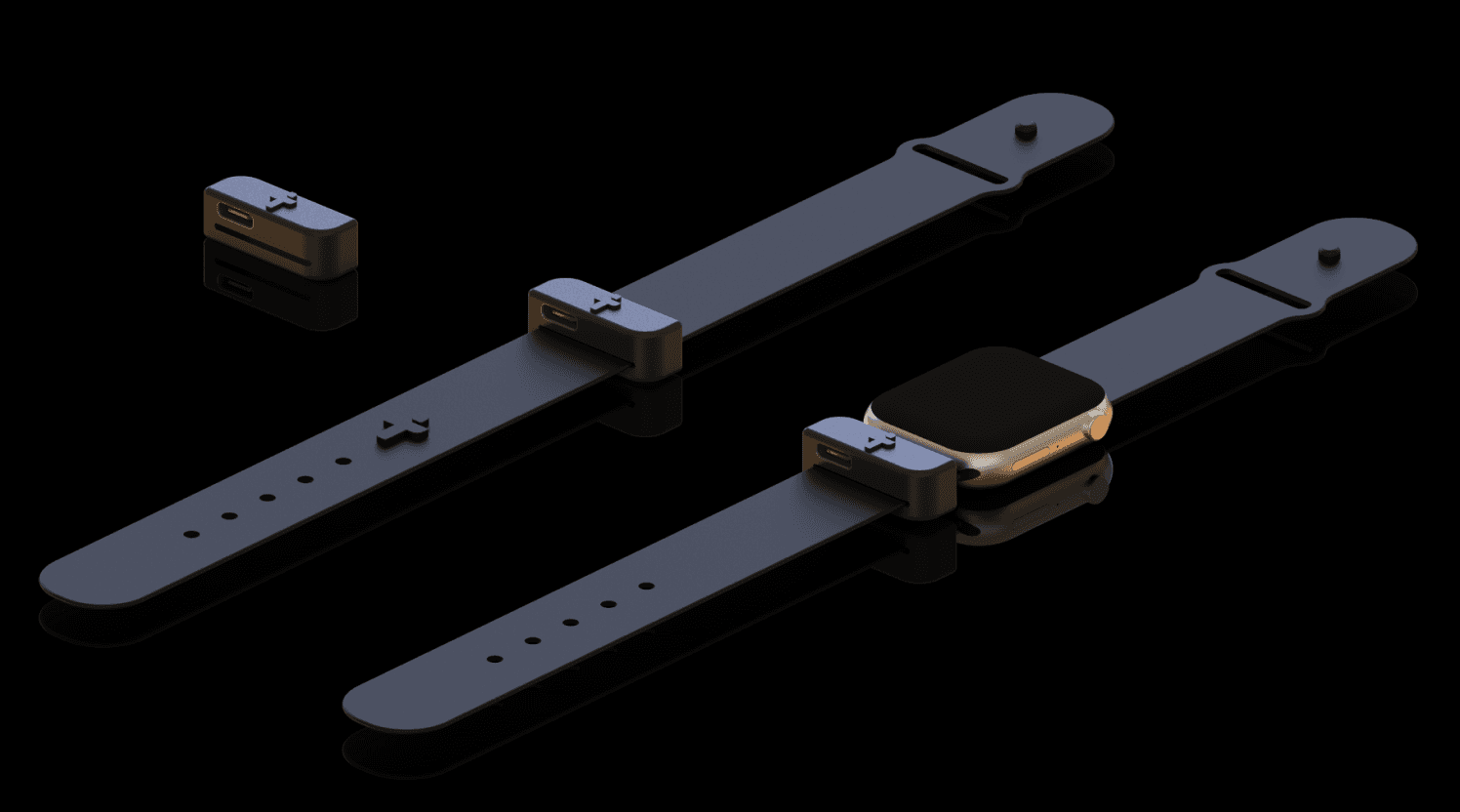

The concept also includes magnetic three-pogo-pin charging and a compact enclosure designed to sit alongside an existing wearable.
The Wearable
Clip-on module, not another watch. InTrack was designed as a module that attaches to a watch or band someone already owns. This lowers the adoption barrier because users do not need to abandon a device they already trust.
The concept also includes magnetic three-pogo-pin charging and a compact enclosure designed to sit alongside an existing wearable.
Designing for Trust
This was the central design challenge. Health interfaces can easily make estimates feel more certain than they really are, so the product needed visible boundaries.

Estimated vs. Calibrated
Blood tests are optional. Without one, results stay estimated; uploading one makes them calibrated. This prevents:
- Making a blood draw a hard barrier to onboarding
- Presenting uncalibrated estimates as precise medical facts
AI guidance vs. clinical review
General education and meal ideas - AI-supported
Daily lifestyle nudges - AI-supported
Supplement changes - Clinician review
Concerning or persistent trends - Telehealth escalation
Diagnosis - Outside product scope
Designing for Trust
This was the central design challenge. Health interfaces can easily make estimates feel more certain than they really are, so the product needed visible boundaries.
Estimated vs. Calibrated
Blood tests are optional. Without one, results stay estimated; uploading one makes them calibrated. This prevents:
- Making a blood draw a hard barrier to onboarding
- Presenting uncalibrated estimates as precise medical facts
AI guidance vs. clinical review
General education and meal ideas - AI-supported
Daily lifestyle nudges - AI-supported
Supplement changes - Clinician review
Concerning or persistent trends - Telehealth escalation
Diagnosis - Outside product scope
Estimated vs. Calibrated
Blood tests are optional. Without one, results stay estimated; uploading one makes them calibrated. This prevents:
- Making a blood draw a hard barrier to onboarding
- Presenting uncalibrated estimates as precise medical facts
AI guidance vs. clinical review
General education and meal ideas - AI-supported
Daily lifestyle nudges - AI-supported
Supplement changes - Clinician review
Concerning or persistent trends - Telehealth escalation
Diagnosis - Outside product scope


Key design decisions
01
Clip-on hardware
The concept complements existing devices rather than competing with them. This reduces switching cost and makes adoption easier to imagine.
02
Three journeys instead of one
Supplement, Diet, and Hybrid support different mental models without creating separate products. One shared system changes its actions and guidance based on the user’s chosen path.
03
Comfort in Uncertainty
Early stages were messy, with many directions, incomplete data, and shifting insights. Embracing that ambiguity taught me to stay open, experiment fast, and trust the iterative process.
04
Guidance ends in action
Knowing that a nutrient may be low is not enough. InTrack connects the insight to a meal, nearby restaurant options, supplement tasks, or professional care.
05
Human review for risks
The AI assistant can support everyday choices, but the product escalates supplement plans and concerning trends to a clinician.
06
Trust comes before monetization
The business hypothesis includes a one-time hardware purchase, a free first year, and a subscription only after the product has built a meaningful personal baseline.
Key design decisions
01
Clip-on hardware
The concept complements existing devices rather than competing with them. This reduces switching cost and makes adoption easier to imagine.
02
Three journeys instead of one
Supplement, Diet, and Hybrid support different mental models without creating separate products. One shared system changes its actions and guidance based on the user’s chosen path.
03
Comfort in Uncertainty
Early stages were messy, with many directions, incomplete data, and shifting insights. Embracing that ambiguity taught me to stay open, experiment fast, and trust the iterative process.
04
Guidance ends in action
Knowing that a nutrient may be low is not enough. InTrack connects the insight to a meal, nearby restaurant options, supplement tasks, or professional care.
05
Human review for risks
The AI assistant can support everyday choices, but the product escalates supplement plans and concerning trends to a clinician.
06
Trust comes before monetization
The business hypothesis includes a one-time hardware purchase, a free first year, and a subscription only after the product has built a meaningful personal baseline.

Business Strategy
The free first year helps solve the calibration cold start and lets InTrack prove its value before asking users to subscribe.
Pricing and user targets are hackathon hypotheses, not validated outcomes.

These are proposed launch targets, not achieved traction.
Business Strategy
The free first year helps solve the calibration cold start and lets InTrack prove its value before asking users to subscribe.
Pricing and user targets are hackathon hypotheses, not validated outcomes.
These are proposed launch targets, not achieved traction.

Building Process
Specify
Before opening Claude Code, I defined how InTrack needed to work as a connected product. This included the onboarding flow, three journey types, Estimated and Calibrated states, shared nutrient data, and the point where AI guidance should hand off to a clinician. These decisions became the foundation of the prototype. Claude could build the interface, but it could not decide what the product should estimate, what needed to remain uncertain, or where its safety boundaries should sit.

Building Process
Specify
Before opening Claude Code, I defined how InTrack needed to work as a connected product. This included the onboarding flow, three journey types, Estimated and Calibrated states, shared nutrient data, and the point where AI guidance should hand off to a clinician. These decisions became the foundation of the prototype. Claude could build the interface, but it could not decide what the product should estimate, what needed to remain uncertain, or where its safety boundaries should sit.
Direct
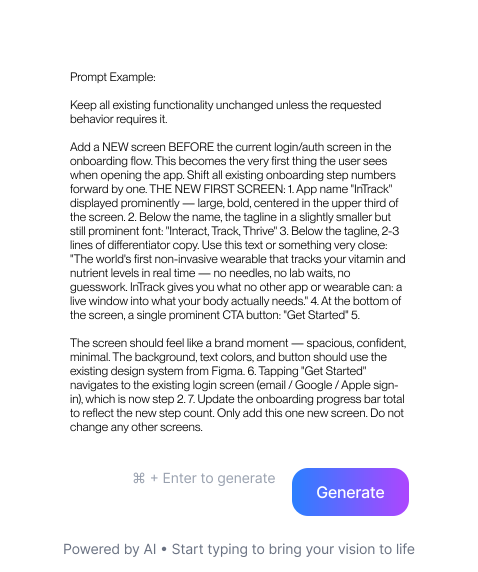
I translated the Figma system and product logic into clear specifications for Claude Code. Each task included the intended behavior, relevant context, constraints, and what a successful result should look like.
Intent
Describes the experience: “Add a brand-first screen before login.”
Acceptance criteria
Defines success: “CTA opens login; steps and progress update.”

Constraints
Defined what could not change: “Use existing Figma styles; change nothing else.”

One rule appeared throughout the build:
Keep all existing functionality unchanged unless the requested behavior requires it.
This mattered because every screen was connected through shared state. Changing the journey type affected Home, Journey, and AI guidance. Uploading a blood test changed Estimated insights to Calibrated. Logging food updated nutrient scores across the app.
The challenge was not generating individual screens. It was making sure every new feature worked with the system already in place.
Direct
I translated the Figma system and product logic into clear specifications for Claude Code. Each task included the intended behavior, relevant context, constraints, and what a successful result should look like.
Intent
Describes the experience: “Add a brand-first screen before login.”
Acceptance criteria
Defines success: “CTA opens login; steps and progress update.”
Constraints
Defined what could not change: “Use existing Figma styles; change nothing else.”
One rule appeared throughout the build:
Keep all existing functionality unchanged unless the requested behavior requires it.
This mattered because every screen was connected through shared state. Changing the journey type affected Home, Journey, and AI guidance. Uploading a blood test changed Estimated insights to Calibrated. Logging food updated nutrient scores across the app.
The challenge was not generating individual screens. It was making sure every new feature worked with the system already in place.
Intent
Describes the experience: “Add a brand-first screen before login.”
Acceptance criteria
Defines success: “CTA opens login; steps and progress update.”
Constraints
Defined what could not change: “Use existing Figma styles; change nothing else.”

Evaluate
I tested each journey from onboarding to action, checking the event order, state changes, visual consistency, health boundaries, and completed features that could be affected by new changes.
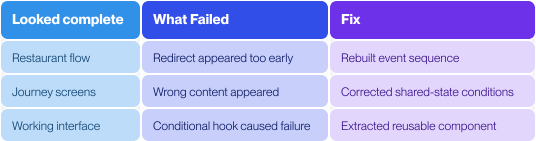
This revealed issues that looked finished on the surface, including an ordering flow that redirected too early, journey content appearing in the wrong state, and a React hook that broke the prototype under specific conditions.
The final result was a deployed React product that could be experienced end to end, not a collection of disconnected screens.
Evaluate
I tested each journey from onboarding to action, checking the event order, state changes, visual consistency, health boundaries, and completed features that could be affected by new changes.
This revealed issues that looked finished on the surface, including an ordering flow that redirected too early, journey content appearing in the wrong state, and a React hook that broke the prototype under specific conditions.
The final result was a deployed React product that could be experienced end to end, not a collection of disconnected screens.

Learning & Reflection
AI Learnings and Next Steps

What it validated
- Three personalized journeys can work within one connected product system.
- Health insights can lead directly to food, supplement, or care actions.
- A detailed Figma system and product specification can become a live React prototype using Claude Code.

What remains unproven
- Sensor accuracy and clinical safety
- User understanding of Estimated vs. Calibrated
- Hardware, business model, and ordering flow viability

What I would test next
- Review sensor feasibility and safety recommendations with specialists.
- Test onboarding, journey selection, and data-confidence labels with users.
- Validate unit economics and whether suggested actions are completed.
Learning & Reflection
AI Learnings and Next Steps
What it validated
- Three personalized journeys can work within one connected product system.
- Health insights can lead directly to food, supplement, or care actions.
- A detailed Figma system and product specification can become a live React prototype using Claude Code.
What remains unproven
- Sensor accuracy and clinical safety
- User understanding of Estimated vs. Calibrated
- Hardware, business model, and ordering flow viability
What I would test next
- Review sensor feasibility and safety recommendations with specialists.
- Test onboarding, journey selection, and data-confidence labels with users.
- Validate unit economics and whether suggested actions are completed.
Overall Learnings
01
Beyond the interface
InTrack required decisions across hardware, software, service design, business strategy, and clinical boundaries. Building the app made those assumptions visible and forced them to work together.
02
AI speeds, humans judge
Claude Code helped me move from product definition to a working prototype quickly. It did not decide which hardware direction reduced adoption barriers, how uncertainty should be shown, when a clinician should enter the loop, or which interactions were safe enough to automate.
03
Specs shaped the design
The quality of the prototype depended on how clearly I defined the system before and during implementation. Product goals, shared state, constraints, event order, edge cases, and acceptance criteria became part of the design work.
Vibecoding did not remove the designer from the process. It moved more of the craft into product definition, system logic, and quality judgment.
InTrack is not presented as a finished medical device. It is a working product prototype that makes a complex health-system idea tangible enough to question, test, and improve.
Overall Learnings
01
Beyond the interface
InTrack required decisions across hardware, software, service design, business strategy, and clinical boundaries. Building the app made those assumptions visible and forced them to work together.
02
AI speeds, humans judge
Claude Code helped me move from product definition to a working prototype quickly. It did not decide which hardware direction reduced adoption barriers, how uncertainty should be shown, when a clinician should enter the loop, or which interactions were safe enough to automate.
03
Specs shaped the design
The quality of the prototype depended on how clearly I defined the system before and during implementation. Product goals, shared state, constraints, event order, edge cases, and acceptance criteria became part of the design work.
Vibecoding did not remove the designer from the process. It moved more of the craft into product definition, system logic, and quality judgment.
InTrack is not presented as a finished medical device. It is a working product prototype that makes a complex health-system idea tangible enough to question, test, and improve.
Opportunity Area
94% of Americans fall short on Vitamin D, 48% miss their Magnesium target, and getting answers can take over 35 days. Apple Health tracks movement, and Cronometer tracks food, but neither connects body signals to a clear next step.
InTrack is a speculative health product and working software prototype. It explores how a clip-on wearable, optional blood-test calibration, and personalized guidance could help people understand nutrient trends and act sooner.
My Role
I led the product design and built the full React prototype with Claude Code, translating the strategy, hardware concept, Figma system, user journeys, shared state, and AI flows into a working product. I defined its behavior, broke it into buildable systems, reviewed outputs, fixed failures, and shipped the final experience.
Let’s create something meaningful together.
rachitsinghi2001@gmail.com
Copy to clipboard



Let’s create something meaningful together.
rachitsinghi2001@gmail.com
Copy to clipboard